The adaptionof current research into the realm of consumer products is a clear sign for me that tactile and haptic technology is the next big thing in human-computer interaction. See the following articles (to be extended):

Blog about non-visual navigation, especially with tactile maps
Wednesday, April 3, 2013

Tuesday, February 19, 2013
Presentations about "Maps for Handicapped People" @ ICC 2001
D.R.F. Taylor (Canada)
|
| Maps for the Blind and Visually Handicapped |
Izabella Krauze-Tomczyk ,Jolanta Korycka-Skorupa (Poland)
|
| Tactile Campus Mapping: Evaluating Designs and Production Technologies |
Chris Perkins (United Kingdom)
|
| How to Make Tactile Maps Discriminable for Touch? |
Yvonne Eriksson (Sweden)
|
A F Tatham (UK)
|
Cecília Maria OKA ,Carla Cristina Reinaldo de SENA (Brazil)
|
Eva Siekierska, Richard Labelle, Linda O’Neil (Canada)
Kostas Papadopoulos, Chryssoula Boutoura, Evangelos Livieratos (Greece)
|
Schematisation of routes in another PhD project
A blog I reguarly read for the pure joy of cartographic material is Beagraphy, written by Beate Weninger. She is a doctoral student of geography from Graz who is doing her PhD about the usability of noise maps in Hamburg. We sometimes meet at the UX roundtable where she presented her former project about 'accoustically enhanced maps'.
Beate's latest post pointed my to the project 'Literaturatlas', co-headed by Lorenz Hurni of ETH Zurich, whom I visited five years ago to speak with him about his work on terrain models, especially reliefs for the blind. The Literaturatlas is a cartographic visualisation of places and routes that are mentioned in literature (see the motivating scenario).
Amoung other visualisation techniques, schematised routes are used to clarify the arbitrariness of routes (in German) when only some (vague) waypoints are mentioned in some text. The concept of schematisation is used here in a similar way as in my dissertation albeit applied to routes not to whole street networks.
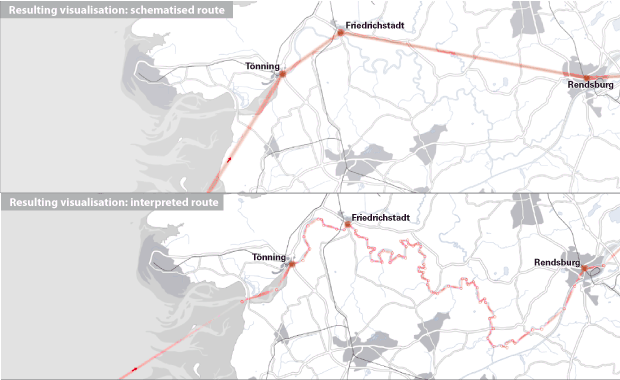
This is the first time that I see the term schematisation used outside of my research group to describe the process of map abstraction. Although it used here to describe a visualisation technique (in cartographic terms, that is generalisation) it is similar to the drawing people produce when externalsing the cognitive schematisation that happens in their minds when listening to route descriptions or reading tactile maps with their fingers.
Beate's latest post pointed my to the project 'Literaturatlas', co-headed by Lorenz Hurni of ETH Zurich, whom I visited five years ago to speak with him about his work on terrain models, especially reliefs for the blind. The Literaturatlas is a cartographic visualisation of places and routes that are mentioned in literature (see the motivating scenario).
Amoung other visualisation techniques, schematised routes are used to clarify the arbitrariness of routes (in German) when only some (vague) waypoints are mentioned in some text. The concept of schematisation is used here in a similar way as in my dissertation albeit applied to routes not to whole street networks.
This is the first time that I see the term schematisation used outside of my research group to describe the process of map abstraction. Although it used here to describe a visualisation technique (in cartographic terms, that is generalisation) it is similar to the drawing people produce when externalsing the cognitive schematisation that happens in their minds when listening to route descriptions or reading tactile maps with their fingers.
Wednesday, February 6, 2013
heise.de berichtet über Navigation für Blinde
heise.de, eins der starken (und m.M. guten) online-Leitmedien, hat heute über die Navigation für Blinde berichtet, ein Anlass für mich, dies auch hier kundzutun. Ich freue mich besonders über die Berichterstattung zu diesen sonst eher als Randthemen eingestuften Arbeiten. Da kann man sicher sein, dass es auch Aufmerksamkeit bekommt, wie ich an zwei unabhängig bei mir eingegangen Mails sehen konnte, die mich auf den Artikel aufmerksam machten.
Ergänzend dazu noch ein paar Links zu einer Technologie, die den Ansatz der Sinnessubstitution verfolgt, allerdings nicht unbedingt auf Navigation ausgerichtet:
Ergänzend dazu noch ein paar Links zu einer Technologie, die den Ansatz der Sinnessubstitution verfolgt, allerdings nicht unbedingt auf Navigation ausgerichtet:
- The vOICe - Seeing with Sound (Peter B.L. Meijer)
- Seeing with your ears (Michael Proulx, Bath University)
- Mit den Ohren sehen - die Hörbrille (ARD Sendung)
Thursday, September 27, 2012
HCI & IxD Conferences 2013
Conferences that are eligable for presenting some of my PhD work on the computer-centric printing of usable tactile orientation maps:
- March, 19-22: INTERNATIONAL CONFERENCE ON INTELLIGENT USER INTERFACES (Santa Monica, USA), Abstracts due Oct 15, papers Oct 22, 2012
- April, 15-18: Ergonomics and Human Factors (Cambridge, UK), Papers due Oct 1, 2012
- April, 27 - May, 02 : CHI 2013 (Paris, France),Oct 5, 2012
- May : HCI 2013 - People and Computers (UK)
- July 1-3 : SOUTH-CHI 2013 (Maribor, Slovenien), papers due Nov 1, 2012
- July, 21-26 : HCI International 2013 (Las Vegas, USA), abstracts due Oct 12, 2012 papers due Feb 1, 2013
- July, 22-27: ICCHP Summer University (Karlsruhe, Germany)
- July, 31 - August, 03 : CogSci 2013 (Berlin, Germany)
- August: International Workshop on Haptic and Audio Interaction Design 2013 (Sweden?), Papers due April (?) 2013
- August, 25-30 : International Cartographic Conference 2013 (Dresden), papers due Nov 1, 2012
- September, 2-6 : INTERACT 2013 (CapeTown, South Africa), 8 January 2013 (abstracts), 15 January 2013 (full papers).
- September: State of the Map 2013
Monday, August 13, 2012
Touch Effects by Reverse Electrovibrations
As follow up to my last post on the development of tactile interfaces and the one before about different approaches to tactile interfaces, Walt Disney researchers present a methods to induce touch effects that works without bulky extra hardware like gloves or force-feedback device but with a thin covering on the display: Feel the touch through electrovibrations. Unfortunately no directional forces can be transmitted as far as I can learn from the description (see below). Insofar the technology is of limited use for guiding the fingers over the surface.
"REVEL is a new wearable tactile technology that modifies the user’s tactile perception of the physical world. Current tactile technologies enhance objects and devices with various actuators to create rich tactile sensations, limiting the experience to the interaction with instrumented devices. In contrast, REVEL can add artificial tactile sensations to almost any surface or object, with very little if any instrumentation of the environment. As a result, REVEL can provide dynamic tactile sensations on touch screens as well as everyday objects and surfaces in the environment, such as furniture, walls, wooden and plastic objects, and even human skin.
REVEL is based on Reverse Electrovibration. It injects a weak electrical signal into anywhere on the user's body, creating an oscillating electrical field around the user’s skin. When sliding his or her fingers on a surface of the object, the user perceives highly distinctive tactile textures that augment the physical object. Varying the properties of the signal, such as the shape, amplitude and frequency, can provide a wide range of tactile sensations." (from the video clip page: http://www.youtube.com/watch?v=L7DGq8SddEQ )
Friday, June 15, 2012
iPhone App supporting blind people's navigation: Ariadna GPS
My colleaque Paolo Fogliaroni pointed me to Ariadne GPS. It seems to be of interest for the scenario I have chosen for my PhD work: Survey knowledge
acquisition with (tactile) maps, most likely for blind people.
"Ariadne GPS is more than a simple gps app. Besides offering you
the possibility to know your position and to get information about the
street, the number, etc. it also lets you explore the map of what's
around you.
What do we mean by saying "explore"? You'll deal with a talking map. If you have VoiceOver activated on your device, you will be able to know the street names and numbers that are around you by touching them. [...] You can also explore a different region than the one around you by telling the app the street and the city."
What do we mean by saying "explore"? You'll deal with a talking map. If you have VoiceOver activated on your device, you will be able to know the street names and numbers that are around you by touching them. [...] You can also explore a different region than the one around you by telling the app the street and the city."
 |
| Screenshot from the app on an iPad - get it here |
The capability I am interested in the most is that this app lets you
know of what's around you with the button "Explore Region". That capability could be compared to a dynamically self-updating You-are-Here map with the user being always in the middle of the map.
A big drawback of any mobile phone based map: it's small and can only cover a very limited part of the environment. This situation is slightly better when using devices with a bigger screen, like the iPad. Another drawback is that the premium channel to convey any meaning to the blind user is voice. Everythings needs to be memorized verbally. Several videos show how that would work, they are also available as audio podcast.
The advent of tactile displays/interfaces could overcome the spatial knowledge acquisition by speech only. But then there is the question how to abstract and optimize the high details visual maps or GIS data to the low detail tactile interfaces. Then my PhD work might come into play.
Subscribe to:
Posts (Atom)